Is College Worth It?

Updated: Feb 9, 2020
“Won’t you eventually have to get a degree if you want to make a good living and support a family?”
As a paramedic who has been involved in EMS since 2011, this is a question that I've been asked many times by many people throughout the years. Some people ask it in the condescending manner which royalty might employ when speaking down to peasants. Others are friends who are genuinely curious how I plan to buy a house and raise children without a great job - achievements that cannot be attained without a college degree.
Or can they?
First off, let’s acknowledge that the average individual income of US workers is currently $30,000. Additionally, there are millions of Americans who do not work at all (usually a conscious decision on their part). Those who reject the traditional college model and instead obtain a certificate can make a much better living than $30,000 per year. Paramedics in the US average $36k a year and can easily increase their worth by studying/training and taking days-long specialty courses like critical care, flight paramedic, rescue diver, tactical paramedic, etc. The median income for an electrician III is currently over $58k a year, despite in many instances, only requiring a few months of training. Labor union construction workers can earn even more than electricians despite having no formal training at all. Such is the case with personal trainers, who can make $70k a year, but who have no real ceiling. Some trainers have clients who pay over $100 for 1 hour long sessions. The list of jobs that have not yet been ruined by the education/licensing bureaucracy (read: cartel) remains quite encouraging. It includes dental hygienist, plumber, contractor, computer programmer, pilot, CDL, mechanic, graphics designer, artist, musician, entrepreneur... the list goes on. These people generally have no student debt, yet they have satisfying, productive, well-paying jobs. They can buy houses and cars and take their families on vacations. They've made it. They've achieved success. Unlike the students who have spent money on college degrees only to fail in college or not find a job, they have made responsible choices in life.
“But Alu, if you go to college, you’ll get an even better job and pay off your debt in no time!”, they insist.
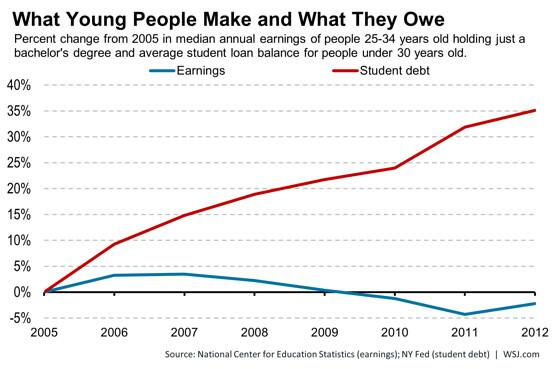
It’s saddening to learn that 68% of 2014 graduates from public and nonprofit colleges finished school with debt, with the average debt per student being over $30,000. The debt was much higher for students who attended private colleges. The average student spends the next 20 years after graduation repaying their student debts.
It is sadder even that only 36% of college graduates in 2014 were able to obtain full-time, permanent employment within five months after obtaining their degrees.
This isn't even the bad news yet. The people who really have it rough are the 41% of students who cannot complete their 4-year degrees, even after 6 years of attending college. They still have to pay off all of their debts.
“Wow, that is sad. Can’t they declare bankruptcy, though?”, one might ask.
They can declare bankruptcy if they want to destroy their credit, but it would do nothing to nullify the debt to their lender if their lender is the federal government. Since the federal government lent over a trillion dollars of the 1.4 trillion borrowed by naive students throughout the US, most students would gain nothing other than embarrassing credit scores from declaring bankruptcy.

“Why has college become so expensive?” would be the next logical question.
Like so many issues plaguing the US, the student debt crisis is in large part the fault of the federal government and their cronies. How? The government gives financial aid and loans to students, which encourages them to endure the ever-increasing prices of college tuition. This is a stark contrast from how the scenario would play out in a country without government intervention in the economy. If the government did not steal from citizens to redistribute wealth in the form of 'tuition assistance', colleges would be punished by students for raising prices and their enrollment would sink proportionally to their tuition increases. This free market principle would force colleges to maintain competitive tuitions, which would, in turn, solve the student debt crisis. Why do so few politicians on TV ever mention this when discussing the apocalyptic ‘student debt crisis’? Because admitting that government intervention caused this problem would mean that the government would have to decrease their taxation and their spending to resolve the issue. That is something that very few politicians would support.
I may not be an expert on all vocations, but EMT’s and paramedics in every area of the US that I know of are able to find work within days of obtaining their state certifications. Judging from the large amount of 'Help Wanted' signs I see on a regular basis, I am confident that people with vocational training can find jobs with relative ease.
The cold hard truth is that people who are not doctors, good lawyers, amazing entertainers, or professional athletes just aren't making a ton of money. If you can make it to the middle class without decades of debt and lost sleep worrying about whether you’ll find a job in your field of study, go for it. My advice is to train in what you are good at and/or what you love and make a living doing it, and don’t let debt control the rest of your life. Over 40 million Americans already made that mistake.
“Alu, the government in its infinite kindness offers so many scholarships, and NY is now giving free tuition to the middle class! This is all irrelevant!”, exclaims the misinformed liberal.
If a student does receive government subsidies in the form of grants, loans, or financial aid, it only means that they’re passing their college bill onto taxpayers like you and me and perpetuating the cycle of tuition inflation. Additionally, if the trillion dollars redistributed from earners to students by the federal government translated into academic success, we would not have seen a decrease in the US workforce participation rate and stagnant incomes over the past decade.
Despite a college education affording students the chance to earn more over their lifetime if they are to find a job in their field, one must consider whether that possibility is worth spending 4 or 6 years studying, not earning money, and spending themselves into serious debt. All you need in order to make a good living in this great country is to produce goods or offer services that others are willing to pay for. In many cases, all that is required in order to do so is some training and a state certification or license. Why do you even need a license to work as a masseuse or a barber? We hope to explain that in a future article on the occupational licensing mafia that is the government...
The views expressed in this article do not necessarily reflect the views held by The Liberty Block or any of its contributors or members.


Comments